What Is Pickleball? The Fast-Growing Sport for All Ages

Pickleball mixes tennis, badminton and table tennis into a game you can pick up in an afternoon. You hit a perforated plastic ball with a solid paddle over a low net, on a court small enough to fit in a driveway. That low barrier to entry is why it has gone from a backyard invention to the fastest-growing sport in the United States, and why courts are filling up everywhere from school halls to retirement villages. Here's what pickleball is, how it's played, who runs it, and how to start.

Key Takeaways:
What it is: Pickleball is a paddle sport blending tennis, badminton and table tennis, played with a perforated plastic ball on a badminton-sized court.
Easy to start: Simple rules, cheap gear and a small court make it genuinely beginner-friendly across all ages and fitness levels.
It's booming: It's been named the fastest-growing sport in the United States for four years running, with close to 20 million American players in 2024.
The rules have quirks: An underhand serve, the two-bounce rule and the no-volley "kitchen" are the three things every new player needs to learn.
Governance is still settling: Strong national bodies exist, but two rival world federations are competing to lead the sport, and it isn't an Olympic sport yet.
The name is a myth-buster: It was named after the "pickle boat" in crew racing, not, despite the popular story, after a dog.
Table of Contents
What pickleball actually is
Pickleball is a paddle sport played on a court the size of a badminton court, with a net a little lower than a tennis net. You use a solid paddle, larger than a table-tennis bat, to hit a light plastic ball riddled with holes. It can be played as singles or, far more commonly, as doubles.
The appeal is how quickly it clicks. The ball is slow compared with a tennis ball, the court is small, and the rules reward placement and patience over raw power. A complete beginner can rally on their first session, which is rare in racket sports. That accessibility, rather than any one feature, is what has pulled in players of every age.
A short history
Pickleball was invented in the summer of 1965 on Bainbridge Island, Washington, by Joel Pritchard, Bill Bell and Barney McCallum. The story is well documented, the families were bored, a badminton set was missing pieces, so the men improvised with table-tennis paddles and a plastic ball over a lowered net. They liked how the ball bounced on the asphalt, dropped the net to roughly hip height, and wrote rules that deliberately gave adults no height advantage over kids.
The name has a stubborn myth attached. The popular version says it came from the Pritchards' dog, Pickles. USA Pickleball's own account traces the name instead to the "pickle boat" in crew racing, the boat crewed by leftover rowers from other teams, a nod to how the game was thrown together from bits of other sports. Joan Pritchard coined it, and the dog Pickles wasn't born until 1968, three years after the game already had its name.
From that one backyard court the sport spread slowly for decades, then exploded in the 2010s. Today it's played worldwide, with professional tours and national championships.
How a game is played
The basics take five minutes to learn. Three rules give pickleball its distinctive rhythm, and they're the ones new players trip over:
The serve is underhand. You strike the ball below waist height, hit diagonally into the opposite service area. A "drop serve," where you drop the ball and hit it after the bounce, is also allowed.
The two-bounce rule. After the serve, the ball must bounce once on the receiving side, and the return must bounce once on the serving side, before anyone is allowed to volley (hit it out of the air). This single rule is what stops the serving side rushing the net and keeps rallies going.
The kitchen. A 2.13-metre zone either side of the net is the non-volley zone, nicknamed the kitchen. You can't volley while standing in it. It exists to stop players smashing every ball from point-blank range, and learning to play around its edge is most of the game's strategy.
Scoring is the other quirk. Games are usually played to 11 points, win by two. Traditionally only the serving side can score a point (called side-out scoring), so a lot of a game is spent winning back the serve rather than scoring. Some professional formats now use rally scoring, where every rally is worth a point, but side-out is still the standard you'll meet at a club.

The court and the kitchen
A pickleball court is the same size as a doubles badminton court, and the dimensions are identical for singles and doubles.
Feature | Measurement |
Court length | 13.41 m (44 ft) |
Court width | 6.10 m (20 ft) |
Net height at the sidelines | 0.91 m (36 in) |
Net height at the centre | 0.86 m (34 in) |
Non-volley zone (kitchen) | 2.13 m (7 ft) from the net, each side |
The slightly lower net at the centre matters more than it looks: it rewards keeping the ball over the middle. The kitchen lines are the reference point for almost every tactic, which is why courts are marked so precisely.
The gear you need
One of pickleball's selling points is how little kit it takes to start.
Item | What to know |
Paddle  | Solid-faced, made of wood, composite or graphite. Wood is cheap and heavy; composite and graphite are lighter and easier on the arm. |
Ball 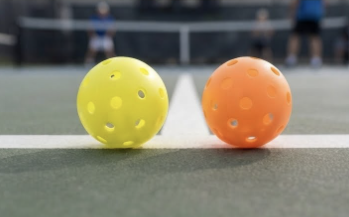 | A light, perforated plastic ball. Indoor and outdoor balls differ (outdoor balls are harder with smaller holes), so match the ball to where you play. |
Shoes  | Court shoes with good lateral support. Running shoes don't handle the side-to-side movement well. |
You don't need your own paddle to try the sport. Most clubs lend or hire them, so borrow before you buy and work out what weight suits you.
Who governs the sport, and where to find your national body
Pickleball has strong national bodies but a genuinely unsettled international picture, so it's worth separating the two.
Nationally, most countries have a recognised governing body that runs competitions, ratings and coaching pathways:
Country | National body | Notes |
Australia | The national governing body, formed in 2020 | |
United States | The sport's first oversight body, founded in 1984 | |
United Kingdom | Recognised by the UK home-nation sports councils as England's national governing body | |
Canada | The national governing body |
Internationally, things are still being fought over. Two rival world bodies are competing to lead the sport: the Global Pickleball Federation (GPF), formed in 2023 when the United States, Australia, Canada and others broke away to start it, and the International Pickleball Federation (IPF). Both want pickleball in the Olympics, but no single federation is recognised by the International Olympic Committee yet, so Olympic pickleball is an ambition rather than a date in the calendar. For a beginner none of this matters, but if you want to compete or get rated, your national body above is the place to start.
Why pickleball has taken off
The growth figures are striking. In the United States, the Sports & Fitness Industry Association named pickleball the fastest-growing sport for four years running from 2021 to 2024, reaching 19.8 million participants in 2024, a 311% rise in three years.
Washington State went as far as making it the official state sport in 2022.
It's a global story, not just an American one. In Australia, the Australian Sports Commission's AusPlay data found that over 92,000 Australians had played pickleball in the year to June 2024. In Canada, Pickleball Canada's 2025 survey put the number who play at around 1.5 million.
The reasons behind the surge are consistent everywhere: the gear is cheap, the rules are easy, the court is small, and the doubles format is sociable. Because it's low-impact and forgiving, it bridges generations in a way few sports manage, which is exactly why it keeps showing up in community centres and clubs.
You can see that play out locally. In Melbourne's west, when Y Victoria was reappointed to run the RecWest centres at Footscray and Braybrook for Maribyrnong City Council in 2023, CEO Carolyn Morris named pickleball, alongside inclusive basketball and gymnastics, among the activities whose growing popularity was drawing more people through the doors. For a not-for-profit built on the idea that everyone belongs, a cheap, low-impact, easy-to-learn sport is a natural way to bring a diverse community together.
The social and physical benefits
That accessibility comes with real health returns. Pickleball sits at a moderate exercise intensity. Players average around 110 heartbeats a minute and burn roughly 350 calories an hour so about four and a half hours of play a week meets the 150 minutes of activity health agencies recommend. A peer-reviewed review in the Journal of Physical Activity and Health found that six weeks of regular play improved players' blood pressure, cholesterol and cardiorespiratory fitness, and the small court and slow ball keep the impact lower than running-heavy sports.
The social side is just as well documented, and for many players it's the real draw. Pickleball is mostly played as doubles, in clubs and drop-in sessions where rotating partners and a chat between games are built into the format. A 2025 systematic review in Frontiers in Psychology links participation to greater life satisfaction, happiness and lower rates of depression, with the gains strongest among older adults, often through the connection the game builds. A separate national survey of US adults over 50 tied playing to lower loneliness and isolation, which matter to long-term health as much as the exercise does.
How to get started
Getting on court is the easy part. Most areas now have clubs that run free or cheap "come and try" sessions, and many lend paddles and balls to newcomers. A quick search for a club near you, or a look at your national body's club finder, is usually all it takes.
Once you're there, focus on the three rules that trip beginners up, the underhand serve, the two-bounce rule, and staying out of the kitchen when you volley. Play doubles to start, since it's the social norm and easier on your movement, and don't rush to buy a paddle until you've felt the difference between a few. The rest you'll pick up by playing.
Final Thoughts
Pickleball earns its reputation as a sport for everyone. It's quick to learn, cheap to start, gentle on the body and genuinely social, which is a rare combination and the reason it has spread so fast. Learn the serve, the two-bounce rule and the kitchen, find a local session, and you'll be rallying the same day.
Frequently Asked Questions (FAQ)
Q: What is pickleball, in one sentence?
A: It's a paddle sport that mixes tennis, badminton and table tennis, played with a perforated plastic ball on a badminton-sized court, as singles or doubles.
Q: Is pickleball easy to learn?
A: Yes, unusually so for a racket sport. The ball is slow and the court is small, so most people can rally in their first session. The quirks to learn are the underhand serve, the two-bounce rule and the no-volley kitchen.
Q: What do I need to start?
A: A paddle, a ball and court shoes. Most clubs lend paddles and balls to beginners, so you can try the sport without buying anything.
Q: How do you score in pickleball?
A: Games are usually to 11 points, win by two. Traditionally only the serving side can score, so a lot of play is about winning back the serve. Some pro formats now use rally scoring instead.
Q: Is pickleball an Olympic sport?
A: Not yet. Two rival international federations are competing to lead the sport, and none is recognised by the International Olympic Committee, so Olympic inclusion remains an ambition.
Q: Why is it called pickleball?
A: It was named after the "pickle boat" in crew racing, crewed by leftover rowers. The popular story that it was named after a dog called Pickles is a myth; the dog came along after the name did.