
Chinlone: Myanmar's Sport Where the Only Opponent Is Gravity

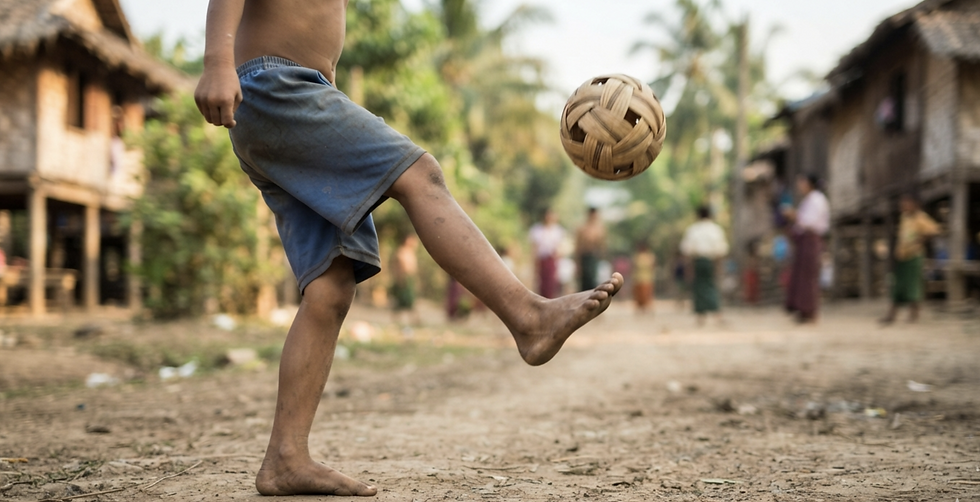
Each year, in the weeks after the full moon of Waso, the grounds beside Mandalay's Mahamuni Pagoda fill with music. A traditional orchestra plays, an announcer calls the names of the moves, and inside a small stadium a circle of six players sends a woven cane ball spinning into the air, catching it on instep, knee, shoulder and heel, to applause that has been gathering here for nearly a century. Nobody is trying to beat anybody. In chinlone, that is the entire point.
Chinlone (say it chin-LONE, often called caneball in English) is Myanmar's national sport, a game believed to stretch back some 1,500 years, played by six people who share a single goal, keeping a rattan ball off the ground as beautifully as they can. It belongs to the same Southeast Asian family as sepak takraw, the net game we've covered in depth, but where takraw added a net and a scoreboard, chinlone kept something older, play as performance, sport as art. This post explores where chinlone comes from, how it works, who keeps it alive, and how to experience it respectfully.
Key Takeaways
No winners, by design: Chinlone is non-competitive; six players work as one team to keep a rattan ball airborne with as much style as possible.
Ancient roots: Popular belief dates the game back some 1,500 years, and a replica silver chinlone ball has been found at a pagoda from the Pyu era.
Two arts in one: The circle game, wein kat, is danced to live music, tapandaing is the solo form, traditionally performed by women.
A national symbol: Codified in 1953 after independence, chinlone became a cornerstone of Myanmar's post-colonial identity and debuted as a contested sport at the 2013 SEA Games.
Heritage under strain: Conflict-driven rattan shortages and worries over participation now threaten the craft behind the ball.
You can see it: The Waso Chinlone Festival at Mandalay's Mahamuni Pagoda reached its 98th edition in 2026.
What You'll Find in This Article
Chinlone at a Glance
Where: Myanmar, where it is the national sport; close cousins are played across Southeast Asia.
Who plays: Teams of six; men, women and children often play together, and it is not unusual to see elders in their eighties in the circle.
The ball: Hand-woven rattan, roughly 13 centimetres (about five inches) across, hollow with pentagonal holes; it clicks like a basket when struck.
The point: Keep the ball airborne using feet, knees, shoulders and head, as creatively as possible. There is no opposing team.
Say it: chin-LONE.
See it: The Waso Chinlone Festival, held after the July full moon at the Mahamuni Pagoda in Mandalay.
A Game With No Opponent
The team form of chinlone is called wein kat, the circle kick. Five players walk slowly around the edge of a circle while a sixth works in the centre, and together they pass the ball with stylised strokes of the feet, knees, shoulders and head. The Olympic Council of Asia's profile of the sport describes how a live orchestra shapes the rhythm of play and an announcer calls out the names of the moves, entertaining the crowd with wordplay as the ball rises and falls.
And there are a great many moves to call.
Chinlone technique draws on traditional Burmese dance and martial arts, and hundreds of distinct touches have been developed over the centuries. Form matters more than anything else: a ball kept up plainly counts for far less than a ball kept up beautifully. Serious players describe entering an intensely focused state they call jhana, a word borrowed from Buddhist meditation, in which nothing exists but the touch and the ball.
That inclusiveness is real rather than rhetorical. Men, women and children often share the same circle, and age is no barrier; the game rewards touch and economy rather than power.
Fifteen Centuries in the Air
How old is chinlone? Popular belief says around 1,500 years, and there is archaeology that gestures the same way: a replica silver chinlone ball was discovered at a pagoda built during the Pyu era, the civilisation that flourished in the Irrawaddy valley between roughly 200 BC and 900 AD. For much of its history the game was a pastime, a form of exercise, and entertainment for royal courts. By the early twentieth century, Burmese performers were touring Europe and Asia with the ball, where colonial audiences enjoyed the spectacle while declining to consider it a sport at all.

Independence changed chinlone's meaning. After British rule ended in 1948, Myanmar's new government looked for traditions that were unmistakably its own, and chinlone, which had survived the colonial period intact, fitted perfectly. In 1953 the head of the Burma Athletic Association, U Ah Yein, was tasked with writing the game's first official rulebook, complete with a scoring system for judging the aesthetics of play, and the first formal competition was held in Yangon that same year. Researchers at Cambridge's Museum of Archaeology and Anthropology describe this deliberate transformation of a folk game into a codified national sport as a statement of post-colonial identity: a young nation championing a game its colonisers had dismissed.
The sport's biggest international stage came in 2013, when Myanmar hosted the SEA Games in Naypyidaw and chinlone made its debut as a contested sport, featuring in the closing ceremony. The competitive scoring remains famously opaque to outsiders, which feels fitting for a game whose deepest values were never about the score.
Tapandaing: The Solo Art
Alongside the circle game sits a second discipline. Tapandaing is solo chinlone, traditionally performed by women, in which a single player keeps the ball alive alone through sequences that blend sport with dance. Performers have historically added theatrical elements to the form, and the discipline demands a repertoire of touches every bit as deep as the team game. Where wein kat is a conversation between six players, tapandaing is a soliloquy, and in Myanmar's chinlone culture the two are held in equal regard.

The Ball, the Makers, and a Craft Under Strain
A chinlone ball is a craft object before it is sporting equipment. In workshops such as those of Hinthada township in the Irrawaddy Delta, makers shave cane into strips, curve them with a hand crank, weave them into a hollow ball patterned with pentagonal holes, then boil it to seal its strength. AFP's 2025 reporting from those workshops found that each ball takes around two hours to make and earns its maker only a few dollars.
The same report suggests the craft is under real pressure. The best rattan comes from Rakhine State, where fighting between the military and opposition groups has made harvesting cane dangerous, and supplies are dwindling. The master makers are ageing, and veteran players worry openly about participation. Yet the game continues, played beneath motorway flyovers and on simple concrete courts, because of what it gives the people who play it.
"Once you get into playing the game you forget everything." — Win Tint, 74-year-old chinlone player, speaking to AFP
Seeing Chinlone: The Waso Festival
Chinlone is woven through Myanmar's Buddhist festival calendar, and one event stands above the rest. The Waso Chinlone Festival, held on the grounds of the Mahamuni Pagoda in Mandalay after the July full moon, has run for nearly a century: the 2026 edition was its 98th, staged over 45 days. In strong years more than a thousand teams have taken part, performing to live traditional music, with homage paid to veteran players on the full moon day and teams' entrance fees offered to the pagoda.
The festival is also where the game's organisation shows itself. Chinlone has no international federation, at home it is organised by the Myanmar Traditional Chinlone Federation, whose Chairman's Cup runs alongside the festival calendar, and in practice its truest custodians are the players, ball makers and festival organisers who keep the tradition moving.
A word for the would-be traveller, in the spirit of respect this game deserves. The festival takes place on pagoda grounds, so dress modestly, with shoulders and knees covered, as Buddhist custom asks. More importantly, much of Myanmar is currently affected by armed conflict, and conditions change quickly, check your government's up-to-date travel advice before considering any trip. For now, the most responsible seat in the house may be a screen, festival footage and Greg Hamilton's documentary Mystic Ball bring the circle to you.
Final Thoughts
Chinlone has outlasted royal courts, colonial condescension, codification debates and decades of upheaval, and it has done so without ever needing a winner. Six people, one ball, and the shared refusal to let it fall: that is a definition of sport worth sitting with. It joins Hornussen in our growing collection of the world's traditional games, each one a reminder that play carries culture as surely as language does. However you come to chinlone, on a screen or one day beside the Mahamuni Pagoda with the orchestra playing, you'll be watching a people keep fifteen centuries in the air.
Go Deeper
Mystic Ball, Greg Hamilton's feature documentary, follows a Canadian player's decades-long devotion to chinlone and remains the definitive film introduction to the game.
The Olympic Council of Asia's chinlone profile covers the game's forms, its Southeast Asian family tree and its festival culture.
Cambridge's Museum of Archaeology and Anthropology hosts a thoughtful essay on chinlone and the colonial encounter, tracing how a folk game became a national symbol.
Al Jazeera's photo essay documents the ball makers keeping the craft alive amid rattan shortages and conflict.


