The Cultural Significance of Traditional Sports around the World

Updated: 3 days ago

Long before stadiums, sponsorships and global broadcasts, communities everywhere played games of their own, contests woven into harvests, festivals, rituals and rites of passage. Traditional sports and games are far more than pastimes: they are living expressions of culture, carrying a community's history, values and identity from one generation to the next.
This article explores why traditional sports matter, takes a regional tour of remarkable games from every continent, traces how traditional games shaped the modern sports we watch today, and explains who is working to protect them. UNESCO recognises traditional sports and games as a form of intangible cultural heritage, and for good reason. If you enjoy discovering the world's lesser-known games, our guides to sepak takraw and Hornussen are good places to start.
Key Takeaways
Culture in motion: Traditional sports encode a community's history, beliefs and identity; they are heritage you can play.
Recognised heritage: UNESCO has inscribed traditional sports from Turkish oil wrestling to Irish hurling as intangible cultural heritage of humanity.
Under pressure: Globalisation, urbanisation and the dominance of a few global sports have pushed many traditional games toward extinction.
Actively protected: Bodies such as UNESCO and TAFISA run international preservation efforts, while Indigenous communities revive their games on their own terms.
Still thriving: From kabaddi's professional league boom to hurling's packed stadiums, many traditional sports are growing, not fading.
There to be watched: Events like the World Nomad Games and Mongolia's Naadam festival put living traditions on full display every year.
What You'll Find in This Article
What We Mean by Traditional Sports
Traditional sports and games are physical contests that have grown out of a particular culture, region or community, often over centuries. They tend to be tied to local identity, played at festivals, tied to the seasons, or rooted in history and ritual. Some, like wrestling, appear in countless forms across the world; others are unique to a single island or valley.
What unites them is meaning. A traditional game is rarely "just" a game: it carries stories, customs and a sense of belonging that mainstream global sports can't easily replicate.
Why Traditional Sports Are Important
The value of traditional sports goes well beyond the scoreboard:
Identity and pride: They express who a community is and where it comes from, reinforcing a shared sense of belonging.
Living history: They pass down knowledge, language, craft and custom: heritage practised rather than merely remembered.
Community and connection: They bring people of all ages together, strengthening social bonds across generations.
Health and wellbeing: Like all sport, they keep people active, but in ways rooted in local culture and accessible to all.
Diversity and dialogue: UNESCO highlights traditional games as vehicles for tolerance, intercultural dialogue and peace.
Traditional Sports Around the World: A Regional Tour
The sheer variety of traditional sport is breathtaking. The tour below is a starting point rather than a complete atlas: several of these games already have full UniquelySport features, and more will follow.
Asia and Central Asia
Kabaddi (South Asia): A breath-holding raid-and-tag game that has grown from village courtyards into one of India's most-watched professional sports leagues.
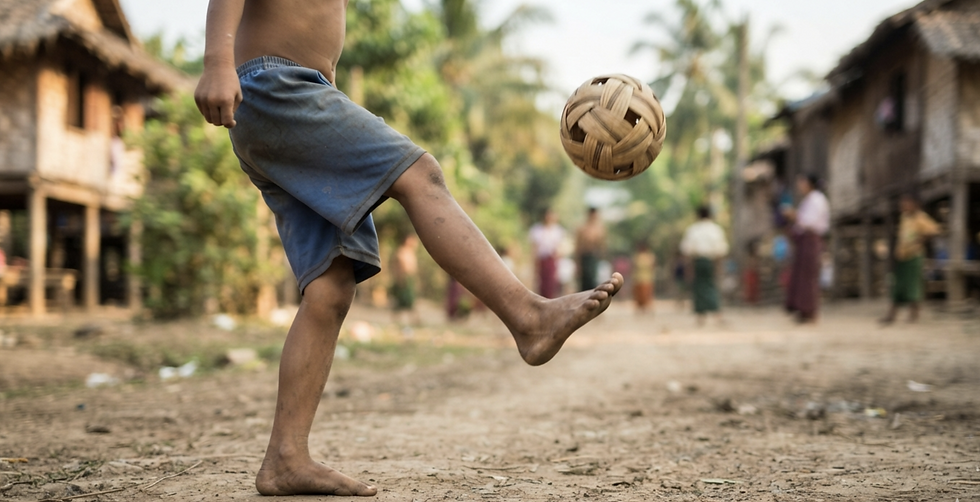
Sepak takraw (Southeast Asia): An acrobatic blend of volleyball and martial-arts kicks. Read our complete guide to sepak takraw.
Ssireum (Korean Peninsula): Traditional Korean wrestling, contested for grip of the satba belt and cherished on both sides of the border.
Sumo (Japan): The wrestling tradition steeped in Shinto ritual, from the salt thrown to purify the ring to the referee's ceremonial dress.
Kok-boru, also known as buzkashi (Central Asia): The fierce horseback contest of the steppe and the headline event of the World Nomad Games.
Europe
Hurling and camogie (Ireland): A stick-and-ball game some 2,000 years old, still amateur and still filling stadiums across Ireland.
Hornussen (Switzerland): The Swiss farmers' game where a puck flies at extraordinary speed toward waiting catchers. Explore our Hornussen feature.
Oil wrestling (Türkiye): Yağlı güreş, whose Kırkpınar festival in Edirne has been held for centuries.
Calcio storico (Italy): Florence's ferocious costumed football, played in the city since the Renaissance.
Africa
Laamb (Senegal): Senegalese wrestling, a national passion that surrounds the bout itself with music, dance and ritual.
Dambe (Nigeria and the Sahel): The traditional boxing art of the Hausa people.
Nguni stick fighting (Southern Africa): A martial tradition of skill, discipline and respect passed down through generations.
The Americas
Lacrosse (Haudenosaunee Confederacy): North America's oldest team sport, created by Indigenous nations long before European colonisation.
Ulama (Mexico): A surviving descendant of the ancient Mesoamerican ballgame.
Tejo (Colombia): The national sport that combines metal discs, targets and gunpowder.
Oceania
Naghol, or land diving (Vanuatu): The sacred vine-jumping ritual of Pentecost Island that inspired the modern bungee.
Marngrook (Australia): Aboriginal football games recorded in Victoria decades before Australian Rules football was codified.
Waka ama (Aotearoa New Zealand and the Pacific): Outrigger canoe racing rooted in Pacific voyaging traditions.
How Traditional Sports Shaped the Modern Game
Traditional games are not a separate world from modern sport; they are its ancestors, and sometimes its living conscience.
The clearest example is lacrosse. The Haudenosaunee Confederacy, made up of the Mohawk, Oneida, Onondaga, Cayuga, Seneca and Tuscarora Nations, created the game centuries ago and still calls it the medicine game, played for healing as much as for competition. When lacrosse returns to the Olympic program at Los Angeles 2028 in its fast-paced Sixes format, it will do so as the direct descendant of an Indigenous tradition. World Lacrosse recognises the Haudenosaunee Nationals as a full member, and whether the game's creators will be able to compete in Los Angeles under their own flag remains one of the most closely watched questions in world sport.
Australia tells a similar story. Accounts of Marngrook, a high-leaping Aboriginal football game, date back to the 1830s in what is now Victoria. Whether Marngrook directly influenced the codification of Australian Rules football is still debated among historians, but the modern game embraces the connection: the AFL's annual Sir Doug Nicholls Round celebrates First Nations players and cultures, and the official match ball for the 2026 round carried the word Marngrook in place of the maker's name.
The pattern repeats across sport. Pentecost Island's Naghol inspired modern bungee jumping, and the folk football games of medieval Europe are the ancestors of today's football codes. Modern sport did not appear from nowhere: it grew out of traditional games, and many of its most distinctive features are inherited.
Why So Many Are Under Threat
Despite their richness, many traditional sports are fragile. Globalisation has spread a handful of commercial sports worldwide, often at the expense of local games. Urbanisation removes the open spaces and village settings these sports depend on. As younger generations move away or gravitate to global media, the chain of transmission can break, and a game that takes centuries to develop can be lost within a generation. UNESCO and its partners note that many traditional sports and games have already disappeared or are at risk.
When a Game Becomes World Heritage
Since the adoption of its 2003 Convention for the Safeguarding of the Intangible Cultural Heritage, UNESCO has treated traditional games the way it treats languages, crafts and festivals: as living heritage that communities have a right to keep alive. A growing number of traditional sports now sit on the Representative List of the Intangible Cultural Heritage of Humanity.
Türkiye's Kırkpınar oil wrestling festival, held annually in Edirne, was inscribed in 2010, the same year as Mongolia's Naadam festival of wrestling, horse racing and archery. In 2018, Ireland's hurling and camogie joined the list in recognition of a game woven into Irish identity for some two millennia.
The most remarkable inscription came that same year, when North and South Korea jointly inscribed ssireum, their shared tradition of belt wrestling. It was the first time the two countries had merged their applications, and it showed what a traditional game can carry on its shoulders.
"The joint inscription marks a highly symbolic step on the road to inter-Korean reconciliation." — Audrey Azoulay, Director-General of UNESCO
Who Is Working to Preserve Them
Because traditional sports have no single global federation, their protection is a shared, international effort:
UNESCO recognises traditional sports and games as intangible cultural heritage and works to safeguard and promote them, including through its traditional sports and games program.
TAFISA (The Association For International Sport for All) partners with UNESCO on global initiatives, such as the Busan Appeal, and stages the World Sport for All Games, a four-yearly festival where nations showcase their traditional sports; the next edition takes place in Riyadh in 2028. Learn more at tafisa.org.
National and regional bodies, museums and communities document, teach and revive local games, often the most important guardians of all.
If a traditional sport in your region has its own association or festival, that is usually the best place to learn, watch or take part.
Indigenous Sport: Revival and Reclamation
For Indigenous communities, traditional sport is not only heritage to be preserved but identity to be lived, and some of the most inspiring developments in world sport are Indigenous games being revived and celebrated on their own terms.
The North American Indigenous Games are the largest continental sporting and cultural gathering for Indigenous youth. The 2023 edition in Halifax welcomed around 5,000 participants from more than 750 Indigenous Nations, and the Games return to Calgary in July 2027, where roughly 6,000 young athletes and coaches are expected.
In the circumpolar North, the Arctic Winter Games have brought young athletes together since 1970. The 2026 edition in Whitehorse gathered around 2,000 participants from northern Canada, Alaska, Greenland and Sápmi, competing in mainstream sports alongside traditional Arctic sports and Dene games.
And in Australia, the AFL dedicates two rounds of every season to the Sir Doug Nicholls Round, celebrating the contribution of First Nations players to the national game; 2026 marks the twentieth year of a dedicated Indigenous round. Together with the Haudenosaunee campaign for Olympic recognition, these events show traditional sport doing what it has always done: telling a people's story to the world.
Where to See Traditional Sports in Action
Traditional sport is best experienced live, and there is a growing calendar of events that welcome visitors:
World Nomad Games: A biennial celebration of the ethnosports of Central Asia, from kok-boru to horseback archery. The sixth edition returns to Kyrgyzstan from 31 August to 6 September 2026, after the 2024 games in Astana drew athletes from 89 countries.
Naadam (Mongolia): Every July, Ulaanbaatar hosts the national festival of wrestling, horse racing and archery, with celebrations held across the country.
Kırkpınar (Türkiye): Each summer, Edirne stages one of the world's oldest continuously held sporting festivals.
TAFISA World Sport for All Games: Held every four years, with delegations demonstrating traditional games from more than 100 countries.
North American Indigenous Games and Arctic Winter Games: The major Indigenous multi-sport gatherings described above, next in Calgary in July 2027 and across the circumpolar North.
Closer to home, look for Highland games, cultural festivals and community sports days; many feature traditional games, and most are open to curious newcomers.
How You Can Experience and Support Them
You don't need to travel far to engage with traditional sport. Seek out the festivals and events above, or the cultural celebrations in your own region; many feature traditional games. Support local clubs and associations keeping a game alive. And simply learning about these sports, and sharing them, helps keep them visible. Every spectator and newcomer is part of the chain that carries a tradition forward.
Final Thoughts
Traditional sports are among humanity's most joyful inheritances, proof that play and meaning have always gone hand in hand. To watch a centuries-old game is to glimpse a culture's heart in motion. By celebrating, learning and taking part, we help ensure these living traditions are passed on, not lost. Explore a few of the games above, and discover just how rich the world of sport really is.
Frequently Asked Questions
Q. What counts as a traditional sport?
A physical game or contest that has grown out of a specific culture or community, often over generations, and that carries cultural meaning beyond the competition itself.
Q. Why are traditional sports important?
They preserve identity, history and community bonds, promote health and inclusion, and, as UNESCO emphasises, support cultural diversity and intercultural understanding.
Q. Are traditional sports disappearing?
Many are under threat from globalisation and urbanisation, and some have already vanished. This is why UNESCO, TAFISA and local communities work to safeguard them.
Q. Who protects traditional sports and games?
There's no single governing body. UNESCO recognises them as intangible cultural heritage, TAFISA runs global promotion efforts, and national bodies and communities preserve individual games.
Q. Where can I watch traditional sports in person?
Major events include the World Nomad Games in Central Asia, Mongolia's Naadam festival each July, the Kırkpınar festival in Türkiye, and Indigenous gatherings such as the North American Indigenous Games and the Arctic Winter Games. Local cultural festivals are often the easiest starting point.
Q. How can I get involved?
Attend cultural festivals and community events, support local clubs keeping a game alive, and learn about and share traditional sports to help keep them thriving.