
What Is Padel? The Walled-Court Racket Sport Explained


Padel is a doubles racket sport played on an enclosed court where the glass walls are part of the game. It started on a private court in Mexico in 1969 and is now played by more than 35 million people in 150 nations, according to the International Padel Federation. If you've read our guide to pickleball, padel is the other racket sport you'll keep hearing about, and the two are easy to confuse.
Key Takeaways:
What it is: A doubles racket sport on a 20 m by 10 m court enclosed by glass and mesh, where the ball can be played off the walls.
Easy to start: The serve is underarm from below the waist and the ball bounces lower than a tennis ball, which makes early rallies easier to keep going.
Familiar scoring: Padel uses tennis scoring, and from 2026 the professional tours settle long deuce games with a new Star Point.
Growing fast: More than 35 million people play worldwide, and in Australia court numbers grew by more than 50 per cent in the year to April 2026.
Open to more players: Wheelchair padel lets players use two bounces, and inclusive events are spreading through the sport.
Who runs it: Padel Australia, working alongside Tennis Australia, governs the sport here and is a member of the International Padel Federation.
Table of Contents
Padel Quick Facts:
Invented: Mexico, 1969, by Enrique Corcuera.
Court: 20 m long and 10 m wide, enclosed by glass walls and wire mesh.
Players worldwide: More than 35 million, on 77,300 courts across 150 nations (2025).
Australians who've played: More than 90,000 (April 2026).
Biggest stage so far: Padel made its Asian Games debut in Nagoya, Japan, from 28 September to 3 October 2026.
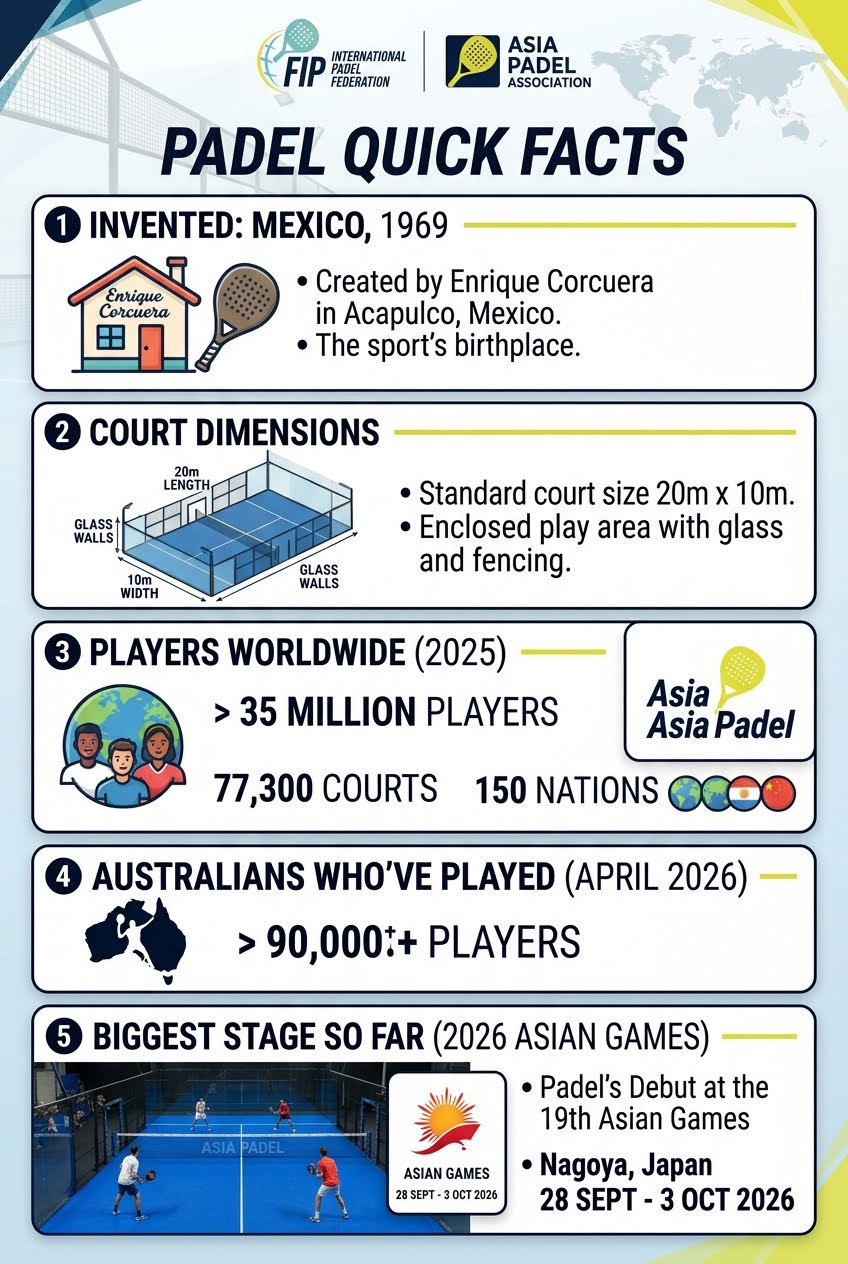
Sources: International Padel Federation, Tennis Australia, Tennis Australia padel guide, Regulations of the Padel Game
What padel actually is
Padel is a racket sport for four players, two a side, on an enclosed court a little smaller than a tennis court. The back walls are glass and the sides are a mix of glass and wire mesh. Once the ball has bounced on your side, it's allowed to hit those walls and you can still play it.
The walls are the reason padel feels so different from tennis. A shot that would be a clean winner on a tennis court often comes back off the glass, and according to Tennis Australia, the walls keep the ball in play longer. Rallies become a game of angles and patience as much as power.
You play with a solid, perforated racket that has no strings, and a ball that looks like a tennis ball but has less bounce. The serve is underarm. If you've played tennis, squash or pickleball, plenty of padel will feel familiar.
Padel is almost always doubles. The official rules are written around pairs, and according to LTA Padel, the sport's governing body in Britain, it's usually played as doubles only.
Where padel came from
According to Tennis Australia, Enrique Corcuera invented padel in Mexico in 1969. He built a smaller court with walls so the ball wouldn't keep escaping into the neighbour's yard, and the game was first known as Paddle Corcuera. Spain's Sports Council changed the spelling to "padel" in 1993.
You'll still see it called padel tennis, including on the Australian Open's website. Both names mean the same sport.
The court, the walls and the gear
The court
The Regulations of the Padel Game set the playing area at 20 m long and 10 m wide. The net is 0.88 m high in the middle, rising to 0.92 m at the posts, and the service lines sit 6.95 m from the net on each side.
The end walls stand 4 m high, with 3 m of solid wall topped by 1 m of metal mesh. The side walls step down from 3 m to 2 m near each end, and mesh fills the rest of the enclosure. According to Tennis Australia, courts are enclosed by glass walls and wire mesh fences, which is why players talk about "the glass".
The racket
A padel racket has no strings. The regulations allow a maximum length of 45.5 cm, a head no wider than 26 cm and a frame no thicker than 38 mm, with the hitting surface perforated by holes of 9–13 mm across the centre. A wrist cord is compulsory, which makes sense once you've seen how close four players stand to each other.
The ball
The ball is rubber, 6.35–6.77 cm across and 56.0–59.4 g. Dropped from 2.54 m onto a hard surface, it has to bounce back to between 135 and 145 cm. According to Tennis Australia, padel balls have less bounce than tennis balls, which suits an enclosed court.
Shoes and clothing
Ordinary sports clothing is fine. Shoes are where it pays to be specific, and Tennis Australia recommends padel shoes with a non-marking sole and a herringbone tread for grip.
How a point works
Every point starts with an underarm serve. The server stands behind the service line, bounces the ball in their own box, and hits it at or below waist height into the box diagonally opposite. You get two attempts, as in tennis.
A serve that lands in the correct box and then hits the glass is good. A serve that lands in the box and then hits the wire mesh before its second bounce is a fault, according to Tennis Australia. The receiver must let the serve bounce before hitting it.
After that, the ball has to cross the net and land on the floor of the other side before it touches any wall over there. Once it has bounced, it can come off the glass or the mesh, and the defending pair can still play it as long as they hit it before it bounces a second time. You can even hit the ball into your own back wall and have it carry over the net, which is a legal return under the regulations.
You lose the point if:
the ball bounces twice on your side;
your shot hits the other side's walls or mesh before it bounces on their floor;
your shot hits your own side's mesh or floor;
you hit the ball twice, or it touches you, your partner or your clothing after your shot;
you touch the net or the posts while the ball is in play.
How padel is scored
If you know tennis, you already know padel's scoring. A game runs 15, 30, 40, game; a set is first to six games with a two-game margin, with a tie-break at six-all; and a match is the best of three sets.
The official regulations also offer a golden point, where deuce is settled by one sudden-death point and the receiving pair picks which side to receive on. Because the rules treat it as an alternative, it's worth agreeing which version you're playing before the first serve.
In 2026 the International Padel Federation introduced the Star Point for Premier Padel, the CUPRA FIP Tour, FIP Promises and the amateur FIP Beyond circuit. At deuce, the pair with advantage wins the game if they take the next point. If they lose it, the score goes back to deuce, and if they lose a second advantage, the game goes to a single Star Point. Its first outing was at FIP Bronze Melbourne in January 2026, so Australia hosted the debut of the sport's newest rule.
Padel and pickleball
Padel and pickleball are often mentioned in the same breath, since both use a stringless racket or paddle and an underarm serve. The walls make them very different games, though. A padel point rewards patience and reading the rebound off the glass, while pickleball's battles happen at the net around the kitchen line. Our padel vs pickleball comparison sets the court, gear, scoring, injury evidence and access side by side, and our pickleball guide covers that sport in full.
Why padel is taking off in Australia
In April 2026 Tennis Australia reported that court numbers had grown by more than 50 per cent in 12 months, and that more than 90,000 Australians had tried the sport. By July, Boss Hunting counted 33 clubs nationally, up from five in 2023, with ten in Sydney and nine in Melbourne.
According to Padel Australia, the Australian Sports Commission officially recognised padel as a sport, and more than 60 coaches qualified through the country's first internationally recognised padel coaching course.
I
n August 2026, a custom-built court went up on the Northern Broadwalk of the Sydney Opera House for the Padel Invitational. Australasian Leisure Management reported that Ash Barty and Pat Rafter played on the Saturday, and community players took the same court on the Sunday for drills with Rafter and Casey Dellacqua.
Australia is still small by global standards. Oceania accounts for about 0.3 per cent of the world's padel players, according to InDaily's reading of the federation's 2025 report. Britain shows where the curve can go. LTA Padel counted 860,000 people playing at least once in 2025, more than double the year before, on 1,553 courts.
The catch for new players is court time. Tennis Australia says most venues are at capacity during peak hours, so book early in the week if you want an evening slot.
Wheelchair and inclusive padel
Padel can be played in a sports wheelchair. In May 2024, Padel Perth Reabold hosted an Inclusive Padel Open Day with sports wheelchairs on loan from Tennis West and the WA Top Spinners wheelchair tennis club. Wheelchair players there could let the ball bounce twice, the same adaptation wheelchair tennis uses.
Internationally, the Inclusive Padel Tour runs a global amateur circuit, founded by Alessandro Ossola, with its first event in Pesaro, Italy, in 2021. According to LTA Padel, each team combines a non-disabled partner with a player who has a prosthesis, uses a wheelchair or has limited motor function, and that player is allowed a second bounce, except those with upper-body impairments or below-knee prostheses.
If you use a wheelchair and want to try padel here, ask your nearest venue whether it has sports chairs and runs adapted sessions. Wheelchair tennis clubs are worth contacting too, since they already have sports chairs, which is how the Perth open day sourced its equipment. Our guide to adaptive sports covers more ways in.
How to start playing padel
Find a court. Padel Australia's court finder lists venues around the country. According to Tennis Australia, some courts are available for casual hire, so you don't need a membership to try it.
Bring three people, or let the venue find them. A court is booked as one unit, so a group of four splits the cost. If you don't have a four, ask whether the venue runs beginner clinics or social sessions that match players by level.
Borrow before you buy. Ask about racket hire when you book. Rackets come in different head shapes, and according to LTA Padel, round heads suit control and diamond heads suit power, so it pays to try a few before buying.
Sort your shoes. Padel shoes with a non-marking, herringbone sole are the one purchase worth making early. If you're not ready to buy, ask the venue what footwear it allows.
Expect the glass to feel strange. If you've played tennis, your instinct will be to hit the ball before it reaches the back wall. Letting it come off the glass first is the main new habit to learn.
Who governs padel, and where to find your national body
The International Padel Federation (FIP) is the world governing body. It had 87 affiliated national federations in 2025, according to its World Padel Report.
In Australia, Padel Australia is the governing body and works alongside Tennis Australia. It's an FIP member and runs tournaments nationally.
Australia: Padel Australia covers tournaments, the national teams, coaching and the court finder.
United States: USA Padel, formerly the United States Padel Association, is the national governing body and is recognised by FIP.
United Kingdom: LTA Padel has governed padel in Britain since 2020, as part of the Lawn Tennis Association.
For other countries, start with the FIP website.
Is padel an Olympic sport?
Not yet. Padel isn't on the program for Los Angeles 2028, and the sports for Brisbane 2032 haven't been decided, according to The Padel Paper. FIP has made an Olympic place its stated goal, and the sport is building a record at multi-sport events. According to the International Padel Federation, padel was a medal sport at the 2023 European Games in Kraków, and in 2026 it has been or will be one at the Mediterranean Games, the South American Games, the Asian Games and the Asian Indoor and Martial Arts Games. Those programs help an Olympic case, but they don't guarantee a place.
Final Thoughts
Padel's appeal is easy to see once you've stepped on a court. The serve is simple, the scoring is familiar, and the walls turn shots you'd lose in tennis into a second chance. In Australia it's gone from five clubs to a recognised sport in about three years, and the hardest part for new players is getting a court.
Book a session, borrow a racket, bring three friends and let the ball come off the glass. If you like what pickleball offers but want longer rallies, padel is the one to try next, and if you're weighing up the two, our padel vs pickleball comparison sets them side by side.
Frequently Asked Questions (FAQ)
Q: What is padel, in one sentence?
A: Padel is a doubles racket sport played with a stringless, perforated racket on a 20 m by 10 m court enclosed by glass and mesh, where the ball can be played off the walls after it bounces.
Q: Is padel the same as padel tennis?
A: Yes. Padel tennis is another name for the same sport, and you'll see both used by venues and tournaments.
Q: Can you hit the ball off the walls in padel?
A: Yes, with one condition. Your shot has to bounce on the other side's floor before it touches their walls. Once it has bounced, it can come off the glass or mesh and still be played, and you can also hit the ball into your own back wall so it carries over the net.
Q: Can you play padel singles?
A: It's possible, but padel is designed for doubles. The official rules are written for pairs, and according to LTA Padel, it's usually played as doubles only.
Q: What is the Star Point in padel?
A: It's a scoring rule introduced in 2026 for the professional tours and FIP circuits. At deuce, the pair with advantage wins the game by taking the next point. If they lose advantage twice, a single deciding Star Point settles the game.
Q: Is padel an Olympic sport?
A: No. It isn't on the program for Los Angeles 2028, and the Brisbane 2032 sports haven't been decided. Padel has been a medal sport at the European Games and, in 2026, made its Asian Games debut.
Q: Do I need my own racket to start?
A: No. Ask about racket hire when you book a court, and play a few sessions before buying so you know what shape and weight suit you.
Q: Can wheelchair users play padel?
A: Yes. Padel can be played in a sports wheelchair, and the rules can be modified to allow two bounces, as in wheelchair tennis. Ask your local venue about adapted sessions and chair availability.


